 BLACK FOREST
Running
On Fumes
- 00Foreword: The Picture They Drew
- 01Expose: Who Drew the Pictureand why
- 02The Billwhat it cost you
- 03Equip: The Fixes Are the Same Machine
- 04Prime: Take It Back on Monday
- ·The Receipts & Disclosures
The Picture They Drew
There was a picture on the wall of almost every classroom in America, and you can probably still see it if you close your eyes. A pyramid. A wide base of bread, cereal, rice and pasta, six to eleven servings a day. Fruit and vegetables in the tier above. Meat and dairy squeezed into a thin band near the top. And at the very tip, in the smallest slice, the fats and sweets you were taught to fear. It hung there for a generation. It shaped how a whole country ate breakfast.
You trusted it, and you were right to want to. It wore the seal of the United States government. It was taught as settled science. So you built your mornings on its base. Cereal and toast. A bagel on the way out the door. Orange juice because it was healthy. Protein, the one thing that holds a body together as it ages, you were quietly taught to treat as a garnish, something to keep near the top of the pyramid and be careful with.
Here is the part nobody put on the poster. That picture was not drawn by people whose job was to keep you strong. It was negotiated by lobbies and propped up by science that had been paid for. Your strength was never what it was protecting.
This guide is the receipt. In the first part we are going to show you exactly who drew the picture and why, with the documents to prove it, because this is not a theory and it is not a rumor. In the second, we are going to show you what a life built on that picture quietly costs your body, in a currency you cannot see on a bathroom scale. In the third, we will show you why even the obvious fixes, the shakes and the bars, were built by the same machine and fail most of the people who reach for them. And in the last part we will hand you the one change you can make on Monday morning to start taking it back. There is nothing to buy on any page of this. That is the point. What you are strong enough to do without us is exactly what we want you to have.
You have been running on fumes. Not because you were lazy or careless, but because the tank was drawn wrong on purpose. Let me show you.
To your strength,
Antonio Colmenares
Founder, Black Forest
Who Drew The Picture
Almost nobody has looked closely at the pyramid since the fourth grade, so start there. Four tiers, and the width of each band was the whole message. The wider the band, the more of it you were told to eat. Grain got the widest band on the chart, six to eleven servings every single day. Protein foods, the meat, fish and dairy, got a thin strip near the top, two to three servings, printed in the same neighborhood as the fats you were told to minimize. A child reading it learned one lesson without a word being spoken. Bread is the foundation. Protein is a risk. Tap through it. See what it actually told you, and who fought to keep it that way.
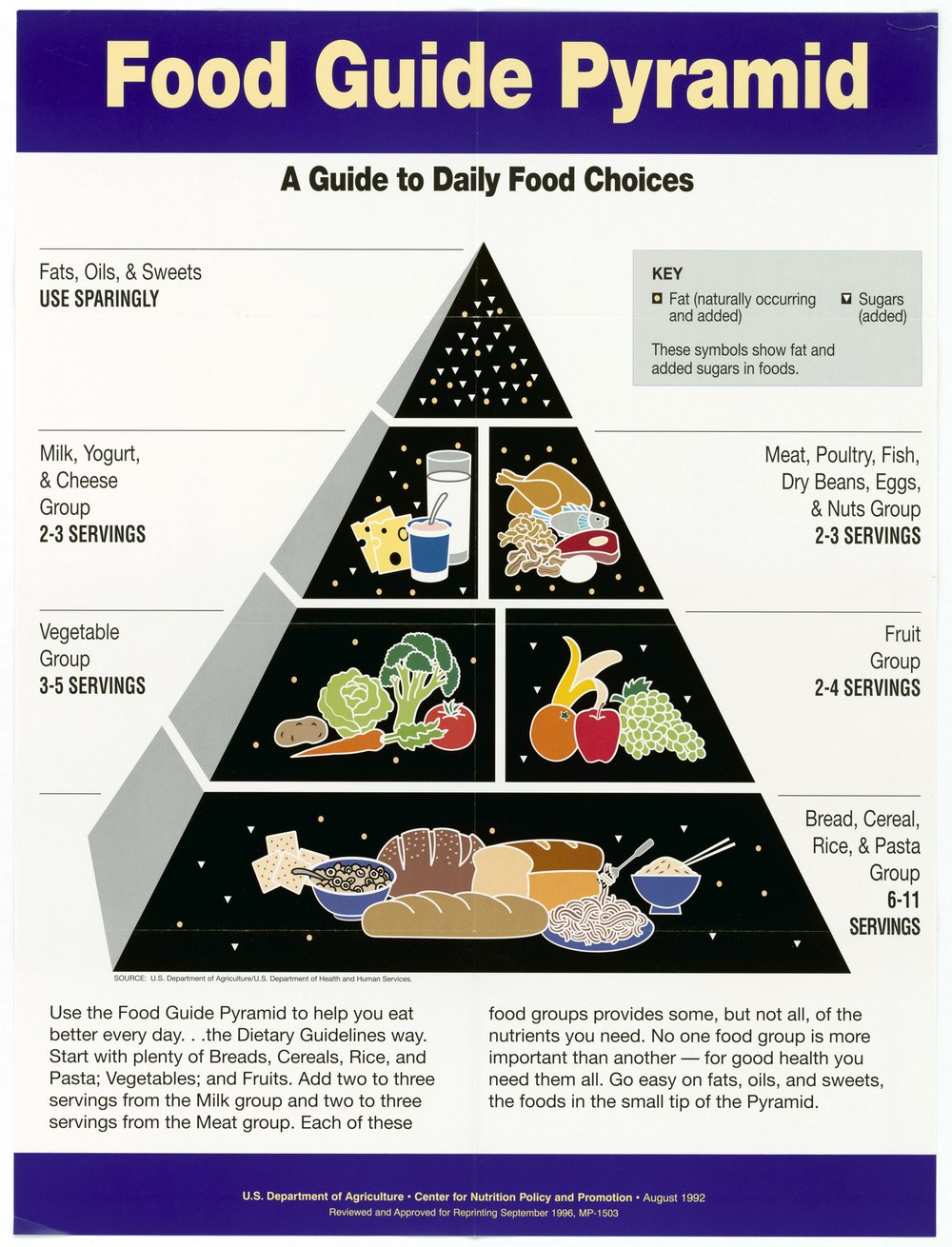
Six to eleven servings sounds absurd until you learn how small a serving was defined to be. One slice of bread. Half a cup of pasta. A single ounce of cereal. Counted honestly, a large bowl of cereal and a sandwich could burn through half your daily grain before lunch. The pyramid did not just recommend a lot of starch. It made a lot of starch look moderate.
The picture was negotiated, not discovered
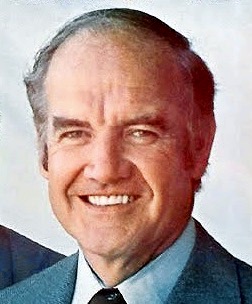
The pyramid was finished, approved, and physically sent to the printer in 1991. Then it was pulled back. Not because a new study had changed the science overnight. Because the meat and dairy industries saw their products sitting in a small band next to the fats, and they objected. The National Cattlemen's Association and the National Milk Producers Federation took their complaint to the government, and the rollout was frozen while the government reworked the presentation to their satisfaction.
This was a pattern, not an accident. Since 1977, when a Senate committee first dared to tell Americans to eat less red meat, the same producers had pushed back until the language was sanded down from decrease consumption of meat to the friendlier have two to three servings a day. And it happened inside an agency built with a conflict at its heart. The United States Department of Agriculture has two jobs that pull in opposite directions. It is charged with promoting the sale of American agricultural products, and it is charged with telling you what to eat. It sells the food and writes the advice at the same desk. When those two jobs collide, history shows which one tends to win.
And the science underneath it had been bought
A base that wide needed a villain to stand beside it, something to take the blame for the heart disease piling up in mid-century America. It got one, and the choice was not made in a lab. In the 1960s a trade group called the Sugar Research Foundation quietly paid a team of Harvard scientists, about the equivalent of fifty thousand dollars in today's money, to write an authoritative review of the evidence on diet and heart disease. The industry set the review's goal in advance, supplied studies to include, and read the drafts. The finished review pointed the finger squarely at fat and cholesterol and waved away the growing evidence that sugar itself drove heart disease. The funding stayed hidden for nearly fifty years.
Follow one of the scientists who took that money and the story closes its loop. He went on to help write the federal government's first national dietary goals, the same 1977 goals that launched the low-fat, high-carbohydrate era and built the base of the pyramid you grew up with. The people who profited from the base paid to choose its villain, and then helped write the rules. Scrub through it.
Fat took the public blame. Sugar got a pass it had paid for. Grain got the widest band on the wall. And protein, the one nutrient that actually defends a body as it ages, got filed next to the danger.
The one number they set too low
Even the single number that could have protected you was set at the floor and sold to you as the ceiling. The official protein recommendation, 0.8 grams per kilogram of bodyweight, sounds authoritative, and it is, for exactly one purpose. It was calculated as the least amount needed to keep the average healthy adult from slipping into outright deficiency. It answers the question, how little can a person get away with. It was never meant to answer the question you actually care about, which is how much does it take to hold your muscle as the years pass.
That second number is much higher, closer to 1.2 and 1.6 grams per kilogram, and it climbs with age rather than falling, because older muscle becomes harder to feed. It develops what researchers call anabolic resistance. The same meal that would have built muscle at twenty produces a smaller response at sixty, so an older body needs more protein per meal, not less, to get the same effect. They handed a fifty-year-old the number designed to keep a twenty-year-old from getting sick. Drag the line and see the gap for yourself.
They took the pyramid down. They kept the machine.
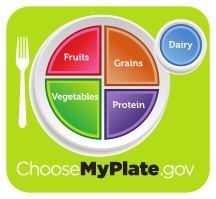
You might reasonably think this all ended in 2011, when the government quietly retired the pyramid after nineteen years and replaced it with a dinner plate called MyPlate. The graphic did change. The capture did not.
Every five years the government convenes a committee of scientists to update the nation's dietary advice, and every five years the same industries go to work on the result. In the run-up to the 2015 guidelines, food and farm groups spent tens of millions of dollars lobbying, more than seventy-seven million from the meat and dairy sector alone across 2014 and 2015. When that year's own scientific advisory committee recommended, in plain language, that Americans eat less red and processed meat, the recommendation was struck from the final guidelines. It did not survive the lobby. Harvard's nutrition experts called it a prime example of industry meddling in public health.
It keeps happening. When a later committee pushed to tighten the limits on added sugar and on alcohol, the final guidelines quietly declined to move. The names on the poster changed. The picture kept being negotiated by the people who profit from what it tells you to eat. For thirty years, through every revision, the thing on your breakfast table never really moved. And then, at the very start of 2026, all at once, it did.
Then, in 2026, they finally flipped it
In January of 2026, a new administration released the next edition of the Dietary Guidelines and, for the first time in the pyramid's history, turned it upside down. The Department of Health and Human Services, under Robert F. Kennedy Jr., and the Department of Agriculture put protein, dairy and healthy fats at the widest part of the picture, alongside fruit and vegetables. The grain that had owned the base for a generation was shrunk to the narrow tip, and Americans were told, for the first time, to avoid highly processed foods and to treat added sugar as something no meal really needs.
And the number changed. The protein recommendation that had sat at 0.8 grams per kilogram since before you were born was raised to between 1.2 and 1.6 grams a day, the same range this guide has been walking you through. The government's own food officials said the old figure had been set to keep people from, in their words, withering away, not to help them thrive. Tap the pyramid at the start of this chapter through to its 2026 state and you can see the shape for yourself.
Take the win, and keep your eyes open. Nutrition scientists have called the whole-foods message sound, including Marion Nestle, whose own documentation of the old capture runs through this very guide; others have warned that the new picture leans hard on meat and dairy, and that the scientific panel still stopped short of formally taking on ultra-processed food. A guideline is a document, not a verdict, and it will be argued over for years.
But here is the part that matters this morning. It took thirty years and a clean sweep of the people in charge for the official picture to finally admit where protein belongs. The habit the old one built did not wait for the correction, and it will not leave on its own. It is still sitting in your kitchen, in the carb-first morning you were handed as a child. Washington redrew the poster. Your breakfast is the one thing no guideline can redraw for you.
What It Cost You
A picture drawn for someone else's profit does not send you an itemized bill. It collects quietly, over decades, in a currency you were never taught to watch. Not fat. Muscle. Starting around the age of thirty, the average adult begins losing muscle at a rate of three to five percent per decade, and the pace quickens with every passing year. It has a clinical name, sarcopenia, but it does not feel like a disease. It feels like nothing at all, until one day it feels like a jar you cannot open. Enter your age and see what it has quietly added up to.
It is tempting to think of muscle as a fixed thing you either have or do not. It is closer to a river. The tissue is torn down and rebuilt every day, in a constant turnover, and protein is both the raw brick and the signal that tells the body to keep building. Cut the supply of either and the rebuilding slows while the tearing down continues. The loss is not aging happening to you. It is a construction site running short on materials.
The forty percent difference
If the loss were simply the price of getting older, there would be nothing to expose and nothing to fix. But it is not. When researchers followed more than two thousand older adults for three years, measuring their muscle with precision scans, the difference the plate made was stark. The adults who ate the most protein lost about forty percent less muscle over those three years than the adults who ate the least. Same three years. Same aging. Roughly forty percent of the damage, prevented, by nothing more exotic than what sat on the plate. Protein is not a minor footnote to growing older. It is the lever, and the picture on the wall was built to keep your hand off it.
The test that reads the balance
You cannot feel muscle leaving. There is no ache, no alarm. But you can measure it, and the clearest window is one you carry everywhere. Your grip. In a study that spanned nearly one hundred forty thousand people across seventeen countries, the strength of a person's grip predicted their risk of dying more accurately than their blood pressure did. Every five kilograms of grip lost tracked a sixteen percent higher risk of an early death. Your hands are not the point. They are the gauge. They report on the strength of everything behind them. Do the test now.
The Fixes Are The Same Machine
Say you have read this far and decided to do something about it. You are going to eat more protein. Good. Here the machine has one last trick, because the obvious solutions were built by the same industry that built the shortage, and each one has a catch. Start with the one almost nobody gets right, which is timing. Your body cannot bank protein the way it banks fat. It runs muscle building in windows, meal by meal, and when a window closes the leftover protein is burned for energy or stored, not saved for later. A splash at breakfast, the eleven grams in a bowl of cereal and milk, opens the window a crack and closes it.
The size of the muscle-building response depends on getting enough protein at each meal to cross a threshold, and then on doing it again at the next one. Stack all your protein at dinner and most of that single large dose overshoots what one window can use. Spread the same amount evenly across the day and you cross the threshold three times instead of once. In a controlled study, that even pattern produced about twenty-five percent more muscle protein synthesis over a day than the dinner-heavy pattern, on the identical total amount of protein. Same groceries. Better timing. Try it yourself. You have ninety grams to place across the day.
The morning is the hardest meal to fix
Now look at where the simulator wants protein most, and look at your actual mornings. The threshold is hardest to clear at exactly the meal the modern morning was built to skip. Coffee and a bar. Cereal. A slice of toast, eaten standing up. Or nothing at all until lunch. The meal that matters most for holding your muscle is the meal the culture treats as optional, and that is not a coincidence. The carb-first, protein-last morning is the pyramid's fingerprint, pressed into breakfast and left there for thirty years.
And the shelf is waiting with more of the same
So you reach for the fixes the same industry sells. Two of them you have almost certainly trusted, and both are quietly rigged.
The most recommended protein powder on earth is also the source of the category's most durable complaint: for a large share of people, it fights the gut. Concentrated dairy protein leaves many of them bloated, gassy and uncomfortable within the hour, which is precisely why so much of the shelf exists to promise a version that does not do that. This is food behaving like food. It is not a moral failing, and it is not in your head. It is a mechanical reason the single most-pushed answer quietly fails a great many of the people who reach for it, and then sells them a second product to solve the problem the first one caused.
Or the other aisle. Tap the bar and read the back.
Ultra-processed. Sugar or sugar alcohols high on the list. Oils, gums, and a protein blend chosen for shelf life, not for you. Candy in a lab coat, sold as the cure for a hunger the same shelf engineered.
The appetite reality
There is one more turn of the screw, and it is happening right now, at scale. More people than ever are eating less than they used to, by discipline or by prescription, at the exact moment their bodies need protein the most to hold on to muscle. When the appetite shrinks, the margin for error disappears. There is less food coming in, so every gram of it has to count, and the timing has to be right, because there is no room left for the waste of a badly built day. Getting this one thing correct has never mattered more than it does for the person eating less.
Take It Back On Monday
Here is the entire fix, and it fits on one line. Make protein the first decision of your day. Not the last, not an afterthought scrambled together at dinner. The first. Front-loading the meal you were already going to eat solves the timing problem in a single move, clears the hardest threshold of the day before the day has a chance to get away from you, and sets the tone for the two meals that follow. It costs nothing, needs no aisle, and asks no one's permission. It is the highest-leverage change a person can make for their aging body, and it has been sitting in plain sight the whole time, filed under the tier the pyramid taught you to keep small.
What enough actually looks like
Aim for roughly twenty-five to forty grams of protein in the morning, enough to clear that threshold once and set up the day. Written down it sounds like a mountain. Built out of ordinary food it is nothing of the kind. Three eggs and a cup of Greek yogurt is already there before you have touched a powder or a bar. Tap a few real foods and watch a real morning add up.
The morning is the hard part because it is the one nobody has a habit for. Once it is built, the rest falls into place. A thirty-gram breakfast, a lunch with real protein at its center rather than as a topping, and a normal dinner, and you have crossed the threshold three times instead of once. That is the whole of what the twenty-five percent study was doing. Not more food. The same food, placed where your body can use it.
Your first seven mornings
A number you do not track is a wish, and a wish does not build a habit. So here is the gift, and unlike the old printable checklist that lived in a drawer and was never seen again, this one lives in your pocket. Seven mornings. Each morning you make protein the first decision, tap the day. It saves itself. Close this, come back tomorrow, and it will remember exactly where you were.
What to expect, honestly
No one rebuilds a decade of lost muscle in a week, and anyone who promises otherwise is selling you the next bar. Here is the honest arc, so you know what to watch for and when.
Steadier energy and a flatter, calmer feeling through the late morning. The mid-morning crash that a bowl of cereal guarantees begins to soften. This part is quick, often within days.
The habit stops taking willpower. Breakfast becomes a decision you have already made the night before. Hunger through the whole day settles, because you started it fed instead of spiking and crashing.
Muscle answers on the scale of months, not days, and only to protein plus a little real effort. But it does answer. Underfeeding and disuse are not one-way doors. The lever was always there. Now your hand is on it.
That is the whole of it. No catch, no checkout page, nothing to add to a cart. The picture on the wall was drawn for someone else's profit. This morning is yours to draw, starting tomorrow.
There is a version of this that takes the friction out of the morning entirely, that makes the first strong decision of your day the easiest one you make. That is a story for another day. For now, you already have everything you need, and you did not have to buy a thing to get it.
To your strength,
Antonio Colmenares
Founder, Black Forest
Be first when it lands.
This guide was the gift, and it stays free whether you ever hear from us again. But there is a version of this that takes the friction out of a protein-first morning entirely, and it drops soon. Leave your number and we will text you the moment it does. Nothing else.
By tapping the button you agree to receive recurring automated marketing texts from Black Forest at this number. Consent is not a condition of purchase. Msg and data rates may apply. Reply STOP to cancel, HELP for help. We never share your number.
The Receipts
- Kearns CE, Schmidt LA, Glantz SA. Sugar Industry and Coronary Heart Disease Research: A Historical Analysis of Internal Industry Documents. JAMA Internal Medicine 2016;176(11):1680.
- Nestle M. Food Lobbies, the Food Pyramid, and U.S. Nutrition Policy. Int J Health Serv 1993; expanded in Food Politics (2002).
- Bauer J, et al. (PROT-AGE Study Group). Evidence-based recommendations for optimal dietary protein intake in older people. JAMDA 2013;14(8):542-559. With Phillips SM on protein requirements and anabolic resistance in aging.
- Volpi E, et al. Muscle tissue changes with aging. Curr Opin Clin Nutr Metab Care 2004.
- Houston DK, et al. Dietary protein intake and lean mass change (Health, Aging, and Body Composition Study). Am J Clin Nutr 2008;87:150-155.
- Leong DP, et al. Prognostic value of grip strength (PURE study). The Lancet 2015;386(9990):266-273.
- Mamerow MM, et al. Dietary Protein Distribution Positively Influences 24-h Muscle Protein Synthesis in Healthy Adults. J Nutr 2014;144(6):876-880.
- USDA Food Guide Pyramid (1992) and MyPlate (2011); 1977 Dietary Goals for the United States; WWEIA/NHANES dietary intake surveys.
- U.S. Department of Health and Human Services & U.S. Department of Agriculture. Dietary Guidelines for Americans, 2025-2030. Released January 7, 2026 (realfood.gov). Contemporary reporting: CBS News, PBS NewsHour, NPR (January 7, 2026).
This guide is educational and is not medical advice. It does not diagnose, treat, cure, or prevent any disease, and the self-checks in it are general assessments, not medical diagnostics. Every historical and numeric claim is drawn from the published sources listed above, not from press coverage. Talk to your physician before changing your diet or exercise, especially if you have a health condition or take medication. Individual results vary.